Why Is a Dental Crown Needed?

  A dental crown may be needed in the following situations:

   1. To protect a weak tooth (for instance, from decay) from breaking or to hold together parts of a cracked tooth
   2. To restore an already broken tooth or a tooth that has been severely worn down
   3. To cover and support a tooth with a large filling when there isn't a lot of tooth left
   4. To hold a dental bridge in place
   5. To cover misshapened or severely discolored teeth
   6. To cover a dental implant

What Types of Crowns Are Available?

Permanent crowns can be made from all metal, porcelain-fused-to-metal, all resin, or all ceramic.

    * Metals used in crowns include gold alloy, other alloys (for example, palladium) or a base-metal alloy (for example, nickel or chromium). Compared with other crown types, less tooth structure needs to be removed with metal crowns, and tooth wear to opposing teeth is kept to a minimum. Metal crowns withstand biting and chewing forces well and probably last the longest in terms of wear down. Also, metal crowns rarely chip or break. The metallic color is the main drawback. Metal crowns are a good choice for out-of-sight molars.
    *

      Porcelain-fused-to-metal dental crowns can be color matched to your adjacent teeth (unlike the metallic crowns). However, more wearing to the opposing teeth occurs with this crown type compared with metal or resin crowns. The crown's porcelain portion can also chip or break off. Next to all-ceramic crowns, porcelain-fused-to-metal crowns look most like normal teeth. However, sometimes the metal underlying the crown's porcelain can show through as a dark line, especially at the gum line and even more so if your gums recede. These crowns can be a good choice for front or back teeth.
    *

      All-resin dental crowns are less expensive than other crown types. However, they wear down over time and are more prone to fractures than porcelain-fused-to-metal crowns.
    *

      All-ceramic or all-porcelain dental crowns provide the best natural color match than any other crown type and may be more suitable for people with metal allergies. However, they are not as strong as porcelain-fused-to-metal crowns and they wear down opposing teeth a little more than metal or resin crowns. All-ceramic crowns are a good choice for front teeth.
    *

      Temporary versus permanent. Temporary crowns can be made in your dentist's office whereas permanent crowns are made in a dental laboratory. Temporary crowns are made of acrylic or stainless steel and can be used as a temporary restoration until a permanent crown is constructed by the dental laboratory.

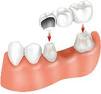
What is a dental bridge?

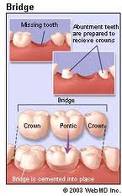
A dental bridge is a false tooth or teeth, known as a pontic, which is fused between two porcelain crowns to fill in the area left by a missing tooth or teeth. The two crowns holding it in place that are attached onto your teeth on each side of the false tooth. This is known as a fixed bridge. This procedure is used to replace one or more missing teeth. Fixed bridges cannot be taken out of your mouth as you might do with removable partial dentures.

In areas of your mouth that are under less stress, such as your front teeth, a cantilever bridge may be used. Cantilever bridges are used when there are teeth on only one side of the open space. Bridges can reduce your risk of gum disease, help correct some bite issues and even improve your speech. Bridges require your commitment to serious oral hygiene, but will last as many ten years or more.


Who is a candidate for dental bridges?

If you have missing teeth and have good oral hygiene practices, you should discuss this procedure with your cosmetic dentist. If spaces are left unfilled, they may cause the surrounding teeth to drift out of position. Additionally, spaces from missing teeth can cause your other teeth and your gums to become far more susceptible to tooth decay and gum disease.
There are three types of dental bridges:


Traditional Fixed Bridge

A dental bridge is a false tooth, known as a pontic, which is fused between two porcelain crowns to fill in the area left by a missing tooth. There two crowns holding it in place that are attached onto your teeth on each side of the false tooth. This is known as a fixed bridge. This procedure is used to replace one or more missing teeth. Fixed bridges cannot be taken out of your mouth as you might do with removable partial dentures.

Resin Bonded Bridges

The resin bonded is primarily used for your front teeth. Less expensive, this bridge is best used when the abutment teeth are healthy and don't have large fillings. The false tooth is fused to metal bands that are bonded to the abutment teeth with a resin which is hidden from view. This type of bridge reduces the amount of preparation on the adjacent teeth.

Cantilever Bridges

In areas of your mouth that are under less stress, such as your front teeth, a cantilever bridge may be used. Cantilever bridges are used when there are teeth on only one side of the open space. This procedure involves anchoring the false tooth to one side over one or more natural and adjacent teeth.
Dr.K.  R.  THAKOR
Dental Surgeon
HOME PAGE
Crowns

What are dental crowns?

Teeth are often restored using  fillings of silver or composite plastics. These materials are more than adequate to restore  the part of the tooth that has been destroyed by tooth decay. However, there comes a point where there is so much  damage to the tooth  structure ,that it cannot hold  a filling. The ideal treatment for such type of teeth are the usage of crowns.  A Crown is a cap like covering that is fitted over a tooth to restore its natural size and shape. A crown strengthens the tooth, protects the remaining tooth structure and can improve appearance. The tooth is trimmed so that the cap can be placed over the tooth like a hat on a head. The crown  also forms an important  unit  of a  fixed bridge which is used for the replacement missing of teeth. 

What are they made up of?

Crowns can be fabricated from different materials depending on the location, color and function of the tooth. Metals are more commonly used to fabricate  the crowns for posterior teeth, although material such as ceramics and other plastic like material are also used

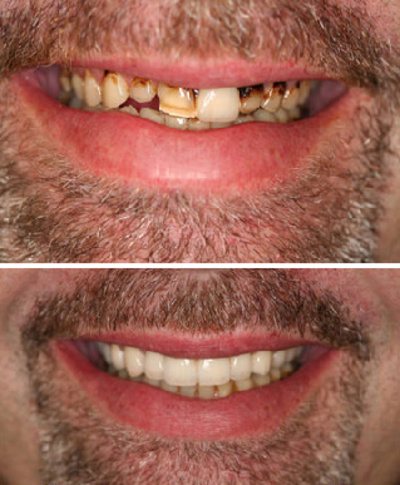
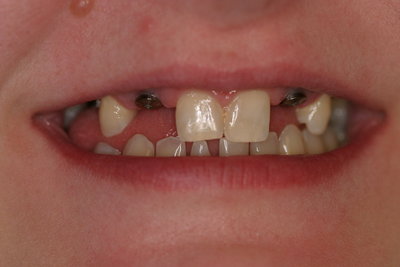
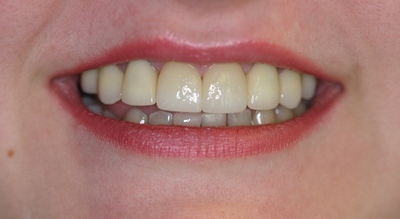
CROWNS & BRIDGES
BEFORE                                     AFTER
BEFORE


AFTER